

MotionBlind: Probing the Illusion of Motion Understanding in Video-LLMs
Paper • 2609.09528 • Published • 1
video video | instance_id string | category string | subtype string | variant int64 | question_1 string | question_2 string |
|---|---|---|---|---|---|---|
02_00 | Speed | successive | 0 | Does the person stir faster the first time compared to the second time? | Does the person stir slower the first time compared to the second time? | |
02_00 | Speed | successive | 1 | Does the person stir faster the first time compared to the second time? | Does the person stir slower the first time compared to the second time? | |
02_01 | Speed | successive | 0 | Does the drawer close faster the first time compared to the second time? | Does the drawer close slower the first time compared to the second time? | |
02_01 | Speed | successive | 1 | Does the drawer close faster the first time compared to the second time? | Does the drawer close slower the first time compared to the second time? | |
02_02 | Speed | successive | 0 | Does the person open their hand faster the first time compared to the second time? | Does the person open their hand slower the first time compared to the second time? | |
02_02 | Speed | successive | 1 | Does the person open their hand faster the first time compared to the second time? | Does the person open their hand slower the first time compared to the second time? | |
02_03 | Speed | successive | 0 | Does the person press the pillow faster the first time compared to the second time? | Does the person press the pillow slower the first time compared to the second time? | |
02_03 | Speed | successive | 1 | Does the person press the pillow faster the first time compared to the second time? | Does the person press the pillow slower the first time compared to the second time? | |
02_04 | Speed | successive | 0 | Once off the ramp, does the ball move faster the first time compared to the second time? | Once off the ramp, does the ball move slower the first time compared to the second time? | |
02_04 | Speed | successive | 1 | Once off the ramp, does the ball move faster the first time compared to the second time? | Once off the ramp, does the ball move slower the first time compared to the second time? | |
02_05 | Speed | successive | 0 | Does the ball travel faster in the second push compared to the first? | Does the ball travel faster in the first push compared to the second? | |
02_05 | Speed | successive | 1 | Does the ball travel faster in the second push compared to the first? | Does the ball travel faster in the first push compared to the second? | |
09_00 | Magnitude | successive | 0 | Does the box travel farther in the second push compared to the first? | Does the box travel farther in the first push compared to the second? | |
09_00 | Magnitude | successive | 1 | Does the box travel farther in the second push compared to the first? | Does the box travel farther in the first push compared to the second? | |
09_01 | Magnitude | successive | 0 | Does the puck travel farther in the second push compared to the first? | Does the puck travel farther in the first push compared to the second? | |
09_01 | Magnitude | successive | 1 | Does the puck travel farther in the second push compared to the first? | Does the puck travel farther in the first push compared to the second? | |
09_02 | Magnitude | successive | 0 | Does the toy car travel farther in the second push compared to the first? | Does the toy car travel farther in the first push compared to the second? | |
09_02 | Magnitude | successive | 1 | Does the toy car travel farther in the second push compared to the first? | Does the toy car travel farther in the first push compared to the second? | |
09_03 | Magnitude | successive | 0 | Does the ball travel farther in the second push compared to the first? | Does the ball travel farther in the first push compared to the second? | |
09_03 | Magnitude | successive | 1 | Does the ball travel farther in the second push compared to the first? | Does the ball travel farther in the first push compared to the second? | |
09_04 | Magnitude | successive | 0 | Does the ball travel farther in the second push compared to the first? | Does the ball travel farther in the first push compared to the second? | |
09_04 | Magnitude | successive | 1 | Does the ball travel farther in the second push compared to the first? | Does the ball travel farther in the first push compared to the second? | |
09_05 | Magnitude | successive | 0 | Does the ball that starts closer to the camera roll further? | Does the ball that starts farther from the camera roll further? | |
09_05 | Magnitude | successive | 1 | Does the ball that starts closer to the camera roll further? | Does the ball that starts farther from the camera roll further? | |
09_06 | Magnitude | successive | 0 | From the camera's point of view, does the right disk move further? | From the camera's point of view, does the left disk move further? | |
09_06 | Magnitude | successive | 1 | From the camera's point of view, does the right disk move further? | From the camera's point of view, does the left disk move further? | |
09_07 | Magnitude | successive | 0 | Is the magnitude of the pendulum arc smaller the first time compared to the second time? | Is the magnitude of the pendulum arc larger the first time compared to the second time? | |
09_07 | Magnitude | successive | 1 | Is the magnitude of the pendulum arc smaller the first time compared to the second time? | Is the magnitude of the pendulum arc larger the first time compared to the second time? | |
09_08 | Magnitude | successive | 0 | Is the drawer pulled out farther the first time compared to the second time? | Is the drawer pulled out less the first time compared to the second time? | |
09_08 | Magnitude | successive | 1 | Is the drawer pulled out farther the first time compared to the second time? | Is the drawer pulled out less the first time compared to the second time? | |
09_09 | Magnitude | successive | 0 | Is the magnitude of the person's arm swing smaller the first time compared to the second time? | Is the magnitude of the person's arm swing larger the first time compared to the second time? | |
09_09 | Magnitude | successive | 1 | Is the magnitude of the person's arm swing smaller the first time compared to the second time? | Is the magnitude of the person's arm swing larger the first time compared to the second time? | |
09_10 | Magnitude | successive | 0 | Is the magnitude of the ball's first bounce smaller the first time compared to the second time? | Is the magnitude of the ball's first bounce larger the first time compared to the second time? | |
09_10 | Magnitude | successive | 1 | Is the magnitude of the ball's first bounce smaller the first time compared to the second time? | Is the magnitude of the ball's first bounce larger the first time compared to the second time? | |
09_11 | Magnitude | successive | 0 | Does the ball travel farther the second time compared to the first time? | Does the ball travel farther the first time compared to the second time? | |
09_11 | Magnitude | successive | 1 | Does the ball travel farther the second time compared to the first time? | Does the ball travel farther the first time compared to the second time? | |
09_12 | Magnitude | successive | 0 | Does the ball travel farther the second time compared to the first time? | Does the ball travel farther the first time compared to the second time? | |
09_12 | Magnitude | successive | 1 | Does the ball travel farther the second time compared to the first time? | Does the ball travel farther the first time compared to the second time? | |
09_13 | Magnitude | successive | 0 | Does the person squeeze with more force the first time compared to the second time? | Does the person squeeze with less force the first time compared to the second time? | |
09_13 | Magnitude | successive | 1 | Does the person squeeze with more force the first time compared to the second time? | Does the person squeeze with less force the first time compared to the second time? | |
09_14 | Magnitude | successive | 0 | Does the cup travel farther the second time compared to the first time? | Does the cup travel farther the first time compared to the second time? | |
09_14 | Magnitude | successive | 1 | Does the cup travel farther the second time compared to the first time? | Does the cup travel farther the first time compared to the second time? | |
14_00 | Direction | translational | 0 | From the camera's point of view, is the man walking to the right? | From the camera's point of view, is the man walking to the left? | |
14_00 | Direction | translational | 1 | From the camera's point of view, is the man walking to the right? | From the camera's point of view, is the man walking to the left? | |
14_01 | Direction | translational | 0 | Is the cup moving towards the sink? | Is the cup moving away from the sink? | |
14_01 | Direction | translational | 1 | Is the cup moving towards the sink? | Is the cup moving away from the sink? | |
14_02 | Direction | translational | 0 | Is the man getting closer to the camera? | Is the man moving farther from the camera? | |
14_02 | Direction | translational | 1 | Is the man getting closer to the camera? | Is the man moving farther from the camera? | |
14_03 | Direction | translational | 0 | From the camera's point of view, is the man moving to the right? | From the camera's point of view, is the man moving to the left? | |
14_03 | Direction | translational | 1 | From the camera's point of view, is the man moving to the right? | From the camera's point of view, is the man moving to the left? | |
14_04 | Direction | translational | 0 | From the camera's point of view, does the pen roll to the right? | From the camera's point of view, does the pen roll to the left? | |
14_04 | Direction | translational | 1 | From the camera's point of view, does the pen roll to the right? | From the camera's point of view, does the pen roll to the left? | |
14_05 | Direction | translational | 0 | From the camera's point of view, does the pen slide to the right? | From the camera's point of view, does the pen slide to the left? | |
14_05 | Direction | translational | 1 | From the camera's point of view, does the pen slide to the right? | From the camera's point of view, does the pen slide to the left? | |
14_06 | Direction | translational | 0 | Does the bottle move up? | Does the bottle move down? | |
14_06 | Direction | translational | 1 | Does the bottle move up? | Does the bottle move down? | |
14_07 | Direction | translational | 0 | Does the phone move closer to the camera? | Does the phone move away from the camera? | |
14_07 | Direction | translational | 1 | Does the phone move closer to the camera? | Does the phone move away from the camera? | |
14_08 | Direction | translational | 0 | Does the book move closer to the camera? | Does the book move away from the camera? | |
14_08 | Direction | translational | 1 | Does the book move closer to the camera? | Does the book move away from the camera? | |
14_09 | Direction | translational | 0 | Does the cup move away from the camera? | Does the cup move closer to the camera? | |
14_09 | Direction | translational | 1 | Does the cup move away from the camera? | Does the cup move closer to the camera? | |
14_10 | Direction | translational | 0 | Is the table top moving up? | Is the table top moving down? | |
14_10 | Direction | translational | 1 | Is the table top moving up? | Is the table top moving down? | |
14_11 | Direction | translational | 0 | Does the toy car move away from the camera? | Does the toy car move closer to the camera? | |
14_11 | Direction | translational | 1 | Does the toy car move away from the camera? | Does the toy car move closer to the camera? | |
14_12 | Direction | translational | 0 | From the camera's point of view, does the ball roll to the camera's right? | From the camera's point of view, does the ball roll to the camera's left? | |
14_12 | Direction | translational | 1 | From the camera's point of view, does the ball roll to the camera's right? | From the camera's point of view, does the ball roll to the camera's left? | |
14_13 | Direction | translational | 0 | Is the cup moving away from the camera? | Is the cup getting closer to the camera? | |
14_13 | Direction | translational | 1 | Is the cup moving away from the camera? | Is the cup getting closer to the camera? | |
15_00 | Direction | rotational | 0 | Is the man bending counter-clock wise? | Is the man bending clock wise? | |
15_00 | Direction | rotational | 1 | Is the man bending counter-clock wise? | Is the man bending clock wise? | |
15_01 | Direction | rotational | 0 | Is the bottle spun clockwise? | Is the bottle spun counter-clockwise? | |
15_01 | Direction | rotational | 1 | Is the bottle spun clockwise? | Is the bottle spun counter-clockwise? | |
15_02 | Direction | rotational | 0 | Is the airpods case spun clockwise? | Is the airpods case spun counter-clockwise? | |
15_02 | Direction | rotational | 1 | Is the airpods case spun clockwise? | Is the airpods case spun counter-clockwise? | |
15_03 | Direction | rotational | 0 | Is the man spinning clockwise? | Is the man spinning counter-clockwise? | |
15_03 | Direction | rotational | 1 | Is the man spinning clockwise? | Is the man spinning counter-clockwise? | |
15_04 | Direction | rotational | 0 | Does the notebook rotate clockwise? | Does the notebook rotate counter-clockwise? | |
15_04 | Direction | rotational | 1 | Does the notebook rotate clockwise? | Does the notebook rotate counter-clockwise? | |
15_05 | Direction | rotational | 0 | Is the cup spun clockwise? | Is the cup spun counter-clockwise? | |
15_05 | Direction | rotational | 1 | Is the cup spun clockwise? | Is the cup spun counter-clockwise? |
A contrastive benchmark for physical-motion perception in Video-LLMs.

📄 Paper: MotionBlind: Probing the Illusion of Motion Understanding in Video-LLMs
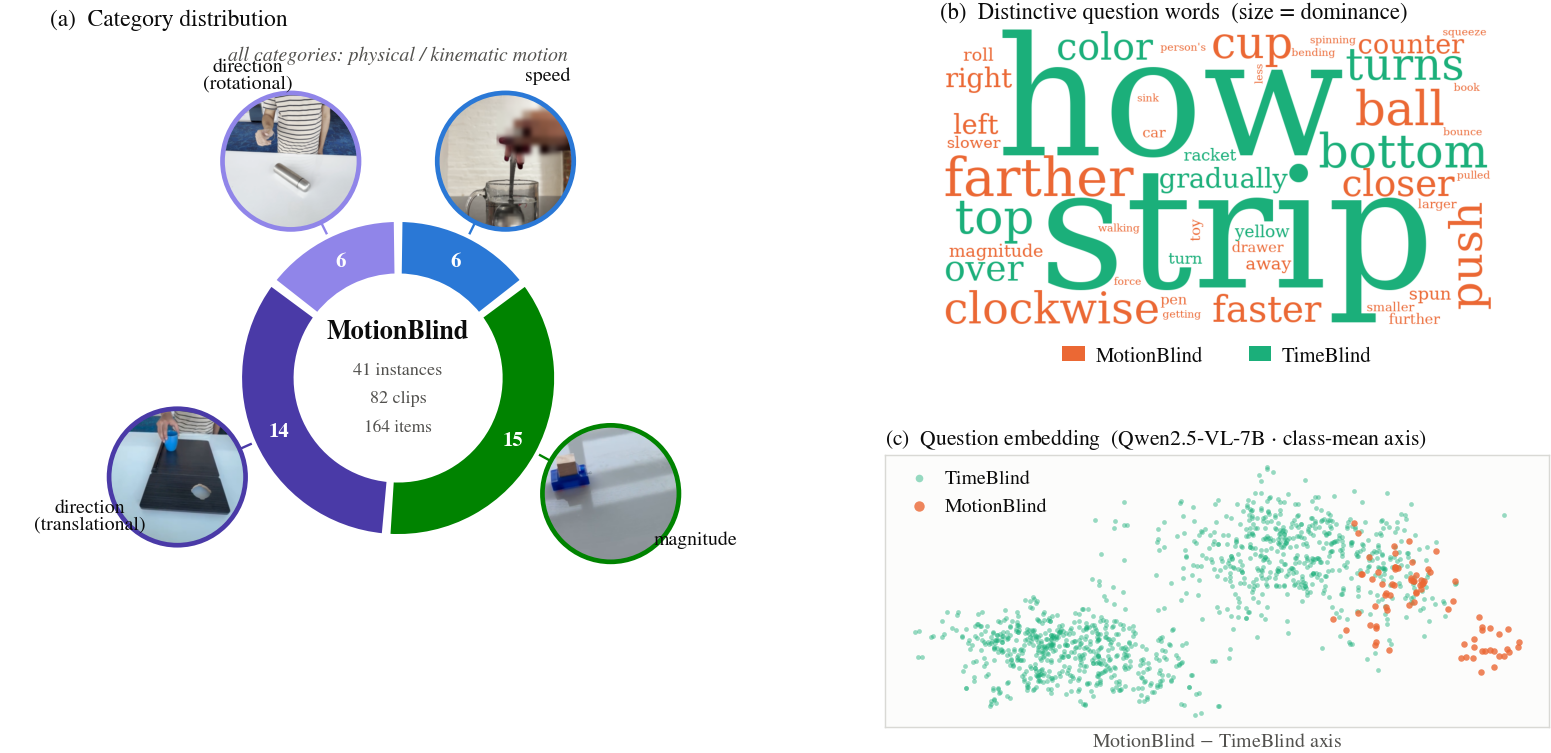
A Video-LLM can watch two clips of the same person in the same room and name every object in both, yet fail to tell you which one moves faster, which way a hand travels, or how far a box slides. MotionBlind is a contrastive, minimal-pairs benchmark built to expose exactly that gap: pairs of near-identical clips that differ only in motion, each paired with two complementary yes/no questions.
Each instance is a 2×2: two near-identical videos ((i_0, i_1)) crossed with two complementary questions ((q_0, q_1)), with a diagonal gold pattern ((q_0) is yes for (i_0) and no for (i_1); vice-versa for (q_1)). Because the paired clips share static content and differ only in motion, a model that ignores the temporal signal cannot satisfy the pattern no matter how good its object recognition is. Single-frame, appearance, and language-only shortcuts all collapse toward the 6.25 % chance floor.
| Instances (2×2) | 41 |
| Clips | 82 |
| Items (video × question) | 164 |
| Answer balance | 50 / 50 yes / no |
| Modality | short self-recorded video + text |
| Language | English |
All categories are physical / kinematic — precisely the variables that are hard to source and label from uncontrolled internet video, but directly controllable in a lab:
| Characteristic | Subtype | Instances | Example question |
|---|---|---|---|
| Speed | successive | 6 | Does the person stir faster the first time than the second? |
| Magnitude | successive | 15 | Does the toy car travel farther in the second push than the first? |
| Direction | translational | 14 | From the camera's point of view, is the man walking to the right? |
| Direction | rotational | 6 | Is the bottle spun clockwise? |
We use the TimeBlind / Winoground-style nested scores (primary = Instance Accuracy):
| Acc | I_Acc | |
|---|---|---|
| Human (mean of 5 annotators) | 97.8 | 91.3 |
| Best open Video-LLM (≤ 8B) | ~60 | ≤ 25 |
| Chance | 50.0 | 6.25 |
Per-item accuracy looks competent, but instance-level discrimination sits near the floor — the illusion the benchmark is named for. See the paper for the full study of open and frontier Video-LLMs.
The default viewer config is a videofolder — each row is a clip with an inline
player plus its two complementary questions (videos/metadata.jsonl):
{"file_name": "02_00_0.mp4", "instance_id": "02_00", "category": "Speed",
 "subtype": "successive", "variant": 0,
 "question_1": "Does the person stir faster the first time compared to the second time?",
 "question_2": "Does the person stir slower the first time compared to the second time?"}
The annotations config exposes the flat item view — data/motionblind.jsonl,
one row per item (164 rows):
{"instance_id": "02_00", "category": "Speed", "subtype": "successive",
 "video": "02_00_0.mp4", "variant": 0, "question_idx": 1,
 "question": "Does the person stir faster the first time compared to the second time?"}
data/instances.jsonl — one row per 2×2 instance (41 rows), with video_0/1 and
question_1/2. Videos live in videos/.
Gold labels. Ground-truth answers are withheld from this release for now. Files are
named <catID>_<pair>_<variant>.<ext>; the scoring follows the diagonal minimal-pairs
pattern described above.
from datasets import load_dataset
from huggingface_hub import snapshot_download

# default config: clips with an inline video column + the two questions
ds = load_dataset("augmentedcognitionlab/MotionBlind", split="test")
ds[0]["video"]        # decoded video
ds[0]["question_1"]   # first question

# flat item view (one row per video x question)
items = load_dataset("augmentedcognitionlab/MotionBlind", "annotations", split="test")

# raw files on disk
path = snapshot_download("augmentedcognitionlab/MotionBlind", repo_type="dataset")
Released under CC-BY-4.0 for research on motion perception in video models. Human faces in all clips are automatically blurred. Please use responsibly.
If you use MotionBlind, please cite:
@article{bhatia2026motionblind,
  title   = {MotionBlind: Probing the Illusion of Motion Understanding in Video-LLMs},
  author  = {Bhatia, Dhairya and Galoaa, Bishoy and Fritsche, Oliver and Kamal, Shahid and
             Salam, Muhammad Obaidullah Abdul and Saleem, Umer and Rastogi, Om and
             Chettiar, Frania Felix and Erdogmus, Nesli and Ostadabbas, Sarah},
  journal = {arXiv preprint arXiv:2609.09528},
  year    = {2026},
  url     = {https://arxiv.org/abs/2609.09528}
}
Maintained by the Augmented Cognition Lab (ACLab), Northeastern University.