

KURE
Collection
KURE: Korea University REtrieval models • 9 items • Updated • 9

KURE-v2 is a Korean-English bilingual late-interaction (multi-vector) retrieval model built on skt/A.X-Encoder-base. It encodes every token into a 128-dimensional vector and scores query–document pairs with MaxSim.
At 154M parameters it averages nDCG@10 0.8160 across the nine MTEB(kor, v2) retrieval tasks — the strongest model on that suite, above every single-vector model measured, including one 175× its size.
It is trained in two stages: unsupervised contrastive pretraining on 20.7M unlabeled pairs (KURE-v2-unsupervised), then supervised fine-tuning with contrastive loss and KL distillation from a reranker.
pip install -U pylate
from pylate import indexes, models, retrieve

model = models.ColBERT(model_name_or_path="nlpai-lab/KURE-v2")

index = indexes.PLAID(
    index_folder="pylate-index",
    index_name="index",
    override=True,
)

documents_ids = ["1", "2", "3"]
documents = [
    "세종대왕은 1443년에 훈민정음을 창제하고 1446년에 이를 반포하였다.",
    "김치는 배추나 무를 소금에 절인 뒤 고춧가루와 젓갈을 넣어 발효시킨 음식이다.",
    "한라산은 해발 1,947m로 남한에서 가장 높은 산이며 제주도 중앙에 자리한다.",
]

documents_embeddings = model.encode(
    documents,
    batch_size=32,
    is_query=False,
    show_progress_bar=True,
)

index.add_documents(
    documents_ids=documents_ids,
    documents_embeddings=documents_embeddings,
)
To reuse an existing index, instantiate it without override:
index = indexes.PLAID(index_folder="pylate-index", index_name="index")
retriever = retrieve.ColBERT(index=index)

queries_embeddings = model.encode(
    ["훈민정음은 언제 만들어졌나요?"],
    batch_size=32,
    is_query=True,
    show_progress_bar=True,
)

scores = retriever.retrieve(
    queries_embeddings=queries_embeddings,
    k=10,
)
To rerank a first-stage candidate list without building an index:
from pylate import models, rank

model = models.ColBERT(model_name_or_path="nlpai-lab/KURE-v2")

queries = [
    "전기차 폐배터리는 어떻게 재활용하나요?",
    "겨울에 한라산을 오를 때 필요한 장비는?",
]
documents = [
    [
        "폐배터리에서 리튬과 코발트를 회수하는 습식 제련 공정이 상용화되고 있다.",
        "급속 충전기는 30분 내외로 배터리를 80%까지 충전할 수 있다.",
    ],
    [
        "겨울 한라산 산행에는 아이젠과 방한 장갑이 필수이며 입산 시간이 제한된다.",
        "제주 올레길은 해안을 따라 이어지는 27개 코스로 구성되어 있다.",
        "적설기에는 등산화에 스패츠를 착용해 눈이 들어가는 것을 막는 것이 좋다.",
    ],
]
documents_ids = [[1, 2], [1, 3, 2]]

queries_embeddings = model.encode(queries, is_query=True)
documents_embeddings = model.encode(documents, is_query=False)

reranked_documents = rank.rerank(
    documents_ids=documents_ids,
    queries_embeddings=queries_embeddings,
    documents_embeddings=documents_embeddings,
)
pip install -U sentence-transformers
from sentence_transformers import MultiVectorEncoder

model = MultiVectorEncoder("nlpai-lab/KURE-v2")

query = "훈민정음은 언제 만들어졌나요?"
documents = [
    "세종대왕은 1443년에 훈민정음을 창제하고 1446년에 이를 반포하였다.",
    "김치는 배추나 무를 소금에 절인 뒤 고춧가루와 젓갈을 넣어 발효시킨 음식이다.",
    "한라산은 해발 1,947m로 남한에서 가장 높은 산이며 제주도 중앙에 자리한다.",
]

query_embeddings = model.encode_query(query)
document_embeddings = model.encode_document(documents)
print(query_embeddings.shape, document_embeddings[0].shape)
# (64, 128) (29, 128)

# MaxSim late-interaction scoring (higher is more relevant)
scores = model.similarity(query_embeddings, document_embeddings)
print(scores)
KURE-v2 is evaluated on the nine MTEB(kor, v2) Retrieval tasks. We report nDCG@10. The results are also shown in the official MTEB Leaderboard
| Model | Params | Avg | AutoRAG | PubHealthQA | Ko-StrategyQA | LawIRKo | SQuADKorV1 | Belebele (ko-ko) | MrTidy | MLDR | MIRACL |
|---|---|---|---|---|---|---|---|---|---|---|---|
| Our Models | |||||||||||
| nlpai-lab/KURE-v2 | 154M | 0.8160 | 0.9718 | 0.8229 | 0.8070 | 0.7550 | 0.9846 | 0.9660 | 0.5974 | 0.7159 | 0.7237 |
| nlpai-lab/KURE-v2-unsupervised | 154M | 0.7283 | 0.8822 | 0.8240 | 0.7818 | 0.7680 | 0.9427 | 0.9525 | 0.3496 | 0.6130 | 0.4411 |
| Late-Interaction (Multi-Vector) Models | |||||||||||
| yjoonjang/colbert-ko-en-v2 | 149M | 0.8063 | 0.9686 | 0.8222 | 0.7940 | 0.7181 | 0.9846 | 0.9687 | 0.5783 | 0.6992 | 0.7230 |
| lightonai/mLateOn | 307M | 0.7906 | 0.9392 | 0.8061 | 0.7905 | 0.6431 | 0.9803 | 0.9608 | 0.5817 | 0.7005 | 0.7135 |
| perplexity-ai/pplx-embed-v1-late-0.6b | 596M | 0.7381 | 0.8557 | 0.8089 | 0.7973 | 0.7285 | 0.9696 | 0.9548 | 0.5400 | 0.2816 | 0.7064 |
| dragonkue/colbert-ko-0.1b | 149M | 0.6776 | 0.9700 | 0.7482 | 0.7364 | 0.4475 | 0.9794 | 0.9644 | 0.3966 | 0.2872 | 0.5685 |
| yjoonjang/colbert-ko-v1 | 149M | 0.6282 | 0.9557 | 0.6783 | 0.6560 | 0.4823 | 0.9594 | 0.9154 | 0.3279 | 0.2214 | 0.4575 |
| Dense (Single-Vector) Models | |||||||||||
| sionic-ai/comsat-embed-ko-8b-preview | 7.6B | 0.7927 | 0.8518 | 0.8871 | 0.8394 | 0.8164 | 0.9168 | 0.9853 | 0.6253 | 0.5157 | 0.6964 |
| Qwen/Qwen3-Embedding-8B | 7.6B | 0.7826 | 0.8276 | 0.8721 | 0.8363 | 0.8171 | 0.9063 | 0.9824 | 0.6187 | 0.5046 | 0.6783 |
| Qwen/Qwen3-Embedding-4B | 4.0B | 0.7737 | 0.8431 | 0.8693 | 0.8270 | 0.7769 | 0.9044 | 0.9522 | 0.6076 | 0.5022 | 0.6803 |
| microsoft/harrier-oss-v1-27b | 27.0B | 0.7667 | 0.8176 | 0.8971 | 0.8361 | 0.8737 | 0.9204 | 0.9546 | 0.5306 | 0.4046 | 0.6653 |
| dragonkue/snowflake-arctic-embed-l-v2.0-ko | 568M | 0.7653 | 0.9093 | 0.8337 | 0.8050 | 0.7735 | 0.9447 | 0.9518 | 0.5712 | 0.4304 | 0.6685 |
| codefuse-ai/F2LLM-v2-8B | 7.6B | 0.7638 | 0.7678 | 0.9380 | 0.8371 | 0.8405 | 0.8874 | 0.9513 | 0.6162 | 0.4047 | 0.6313 |
| telepix/PIXIE-Rune-v1.5 | 568M | 0.7618 | 0.8927 | 0.8426 | 0.8064 | 0.7705 | 0.9457 | 0.9617 | 0.5492 | 0.4482 | 0.6393 |
| nlpai-lab/KURE-v1 | 568M | 0.7616 | 0.8708 | 0.8193 | 0.7999 | 0.7426 | 0.9357 | 0.9502 | 0.5909 | 0.4637 | 0.6816 |
| dragonkue/BGE-m3-ko | 568M | 0.7547 | 0.8738 | 0.8155 | 0.7959 | 0.7322 | 0.9414 | 0.9503 | 0.6099 | 0.3899 | 0.6833 |
| BAAI/bge-m3 | 568M | 0.7509 | 0.8301 | 0.8041 | 0.7941 | 0.7174 | 0.9038 | 0.9316 | 0.6471 | 0.4287 | 0.7015 |
| nlpai-lab/KoE5 | 560M | 0.7337 | 0.8434 | 0.8351 | 0.8001 | 0.7756 | 0.8980 | 0.9425 | 0.5841 | 0.3015 | 0.6235 |
Late-interaction rows were measured with mteb 2.18.16 and PLAID retrieval. Single-vector rows are
taken from the official MTEB results repository,
except for Belebele, where only the Korean-query / Korean-corpus subset is used. The original
version also includes cross-lingual subsets (Korean query – English corpus, English query – Korean
corpus).
KURE-v2 is a late-interaction model: each document is stored as a set of token vectors, so the practical questions for deployment are index size and search cost. We benchmarked KURE-v2 across ANN backends and compression schemes on the 9 Korean MTEB retrieval tasks, against five single-vector baselines served with faiss HNSW. All numbers are end-to-end: batch-1 query encoding + index search, measured serially on one A100 80GB.
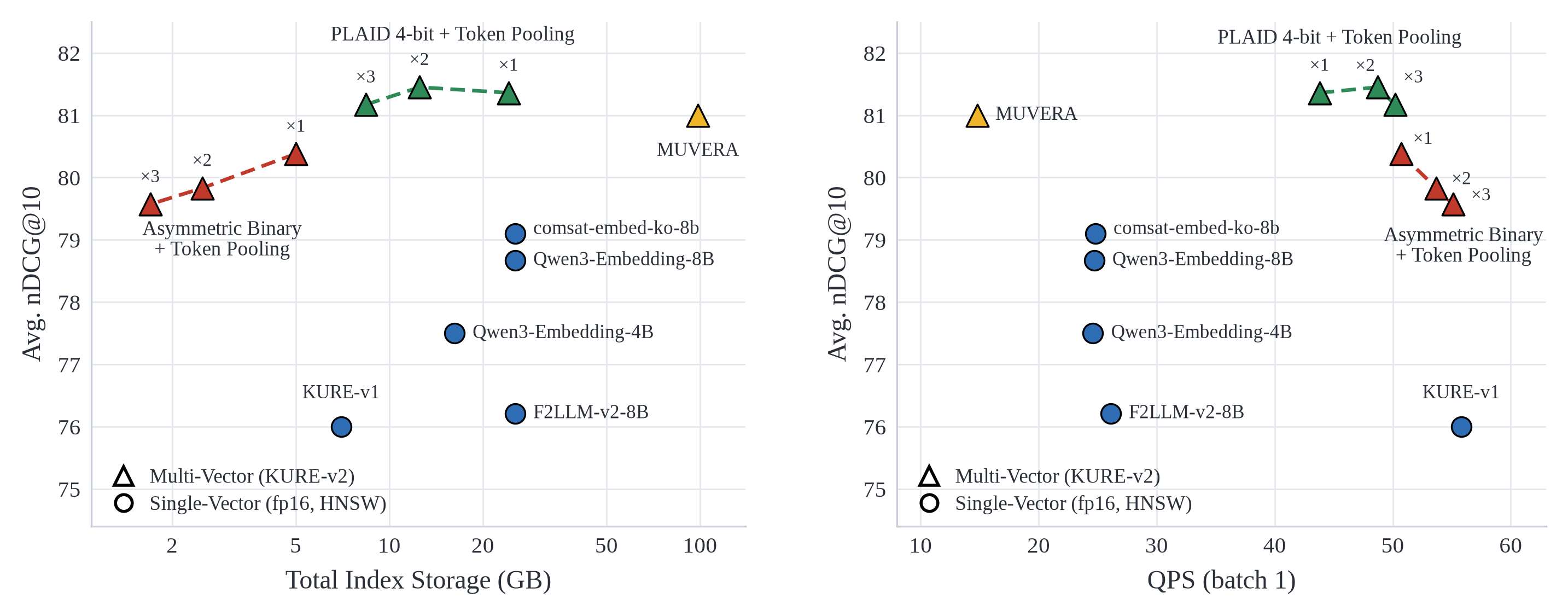
Two things the figures show:

On the largest corpus (MIRACL, ~1.5M documents) an exhaustive 1-bit scan costs O(corpus): p95 climbs to 156 ms, and pooling the tokens 3x only brings it to 74 ms. Generating candidates with faiss BinaryIVF (Hamming search over the same 1-bit index) and re-scoring them with exact asymmetric MaxSim cuts p95 to 38 ms on the same 2.2 GB index, lower tail latency than the 4B-8B single-vector baselines (43 ms) at higher nDCG. For large collections, use a candidate-generating index (PLAID or BinaryIVF), not an exhaustive scan.
IndexHNSWFlat (inner product on L2-normalized embeddings), M=32, efConstruction=200, efSearch=64.@misc{kure-v2,
title = {KURE-v2: a Korean-English bilingual late-interaction retriever},
author = {Jang, Youngjoon and Son, Junyoung and Lee, Taemin and Hong, Seongtae and Lim, Heuiseok},
year = {2026},
url = {https://huggingface.co/nlpai-lab/KURE-v2},
}
@inproceedings{jang2025kure,
  title={KURE: Embedding Model for Korean-Specific Retrieval},
  author={Jang, Youngjoon and Son, Junyoung and Lee, Taemin and Hong, Seongtae and Park, JeongBae and Lim, Heuiseok},
  booktitle={Annual Conference on Human and Language Technology},
  pages={129--134},
  year={2025},
  organization={Human and Language Technology}
}
@inproceedings{santhanam-etal-2022-colbertv2,
  title     = {ColBERTv2: Effective and Efficient Retrieval via Lightweight Late Interaction},
  author    = {Santhanam, Keshav and Khattab, Omar and Saad-Falcon, Jon and Potts, Christopher and Zaharia, Matei},
  booktitle = {Proceedings of the 2022 Conference of the North American Chapter of the Association for Computational Linguistics: Human Language Technologies},
  year      = {2022},
  pages     = {3715--3734},
}
@misc{PyLate,
  title  = {PyLate: Flexible Training and Retrieval for Late Interaction Models},
  author = {Chaffin, Antoine and Sourty, Raphaël},
  year   = {2024},
  url    = {https://github.com/lightonai/pylate},
}
Base model
skt/A.X-Encoder-base