new

Get trending papers in your email inbox!

Subscribe

Trending Papers

byAK and the research community

Trending Papers

TradingAgents: Multi-Agents LLM Financial Trading Framework

A multi-agent framework using large language models for stock trading simulates real-world trading firms, improving performance metrics like cumulative returns and Sharpe ratio.

  • 4 authors
· Dec 28, 2024
Submitted by
liangjiaqing

GenericAgent: A Token-Efficient Self-Evolving LLM Agent via Contextual Information Density Maximization (V1.0)

GenericAgent is a self-evolving large language model agent system that maximizes context information density through hierarchical memory, reusable SOPs, and efficient compression to overcome long-horizon limitations.

Fudan-University Fudan University · Apr 18, 2026

AI-Trader: Benchmarking Autonomous Agents in Real-Time Financial Markets

AI-Trader presents the first fully automated live benchmark for evaluating large language models in financial decision-making across multiple markets with autonomous information processing.

  • 6 authors
· Dec 1, 2025
Submitted by
jianchen0311

DFlash: Block Diffusion for Flash Speculative Decoding

DFlash is a speculative decoding framework that uses a lightweight block diffusion model for parallel token drafting, achieving significant speedup over existing autoregressive methods while maintaining high-quality outputs.

z-lab Z Lab · Feb 5, 2026
Submitted by
hongyyyyy

Adam's Law: Textual Frequency Law on Large Language Models

A novel framework for improving large language model performance through textual frequency analysis, including laws, distillation, and curriculum training approaches.

FaceMind FaceMind · Apr 2, 2026

Kronos: A Foundation Model for the Language of Financial Markets

Kronos, a specialized pre-training framework for financial K-line data, outperforms existing models in forecasting and synthetic data generation through a unique tokenizer and autoregressive pre-training on a large dataset.

  • 7 authors
· Aug 2, 2025
Submitted by
RuofengYang

ARIS: Autonomous Research via Adversarial Multi-Agent Collaboration

ARIS is an open-source research harness that uses cross-model adversarial collaboration to ensure reliable long-term research outcomes through coordinated execution, orchestration, and assurance layers.

Submitted by
akhaliq

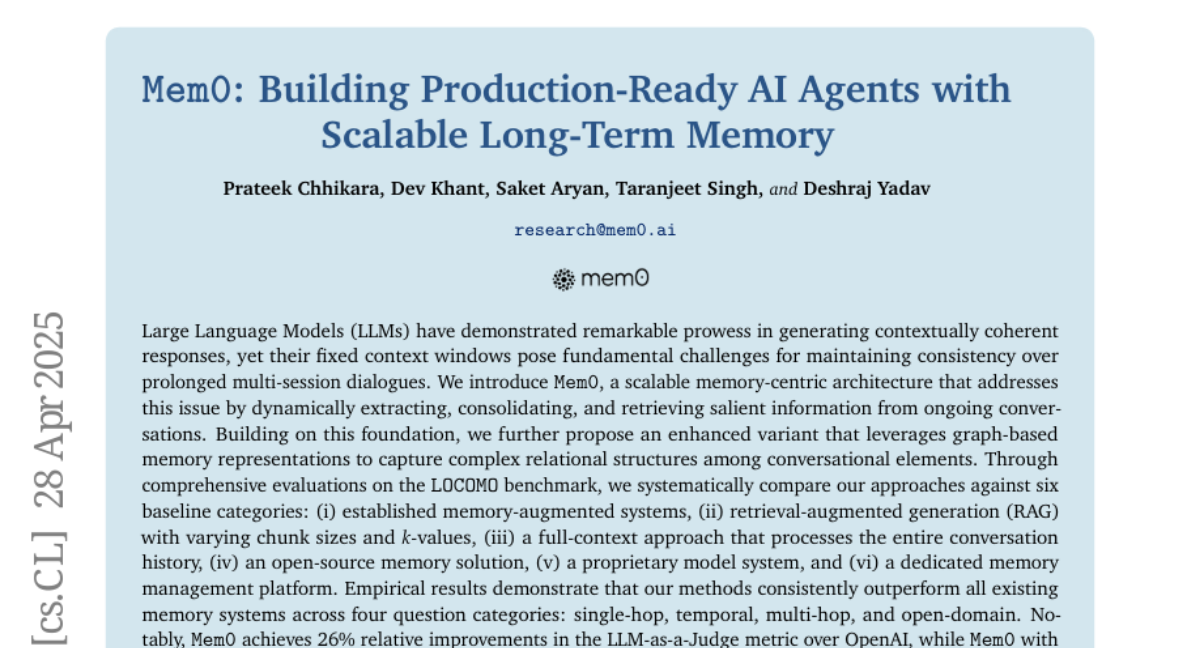
Mem0: Building Production-Ready AI Agents with Scalable Long-Term Memory

Mem0, a memory-centric architecture with graph-based memory, enhances long-term conversational coherence in LLMs by efficiently extracting, consolidating, and retrieving information, outperforming existing memory systems in terms of accuracy and computational efficiency.

  • 5 authors
· Apr 28, 2025
Submitted by
taesiri

MinerU2.5: A Decoupled Vision-Language Model for Efficient High-Resolution Document Parsing

MinerU2.5, a 1.2B-parameter document parsing vision-language model, achieves state-of-the-art recognition accuracy with computational efficiency through a coarse-to-fine parsing strategy.

  • 61 authors
· Sep 26, 2025
Submitted by
akhaliq

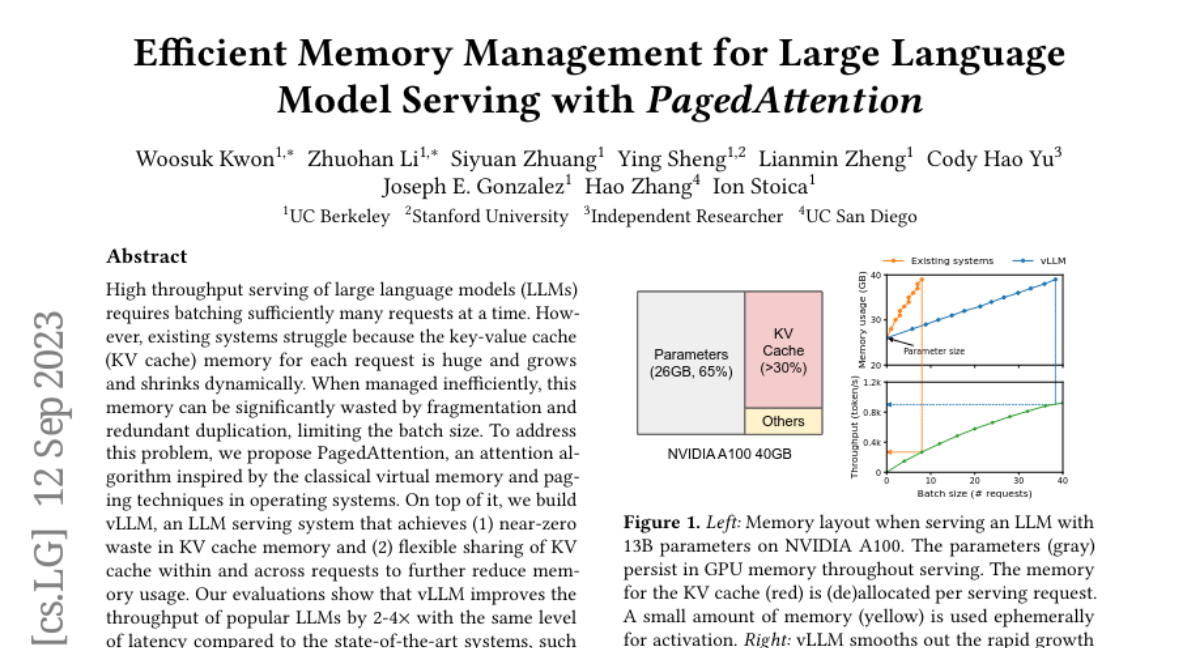
Efficient Memory Management for Large Language Model Serving with PagedAttention

PagedAttention algorithm and vLLM system enhance the throughput of large language models by efficiently managing memory and reducing waste in the key-value cache.

  • 9 authors
· Sep 12, 2023
Submitted by
unilm

VibeVoice Technical Report

VibeVoice synthesizes long-form multi-speaker speech using next-token diffusion and a highly efficient continuous speech tokenizer, achieving superior performance and fidelity.

MicrosoftResearch Microsoft Research · Aug 26, 2025
Submitted by
taesiri

PaddleOCR-VL: Boosting Multilingual Document Parsing via a 0.9B Ultra-Compact Vision-Language Model

PaddleOCR-VL, a vision-language model combining NaViT-style dynamic resolution and ERNIE, achieves state-of-the-art performance in document parsing and element recognition with high efficiency.

PaddlePaddle PaddlePaddle · Oct 16, 2025
Submitted by
akhaliq

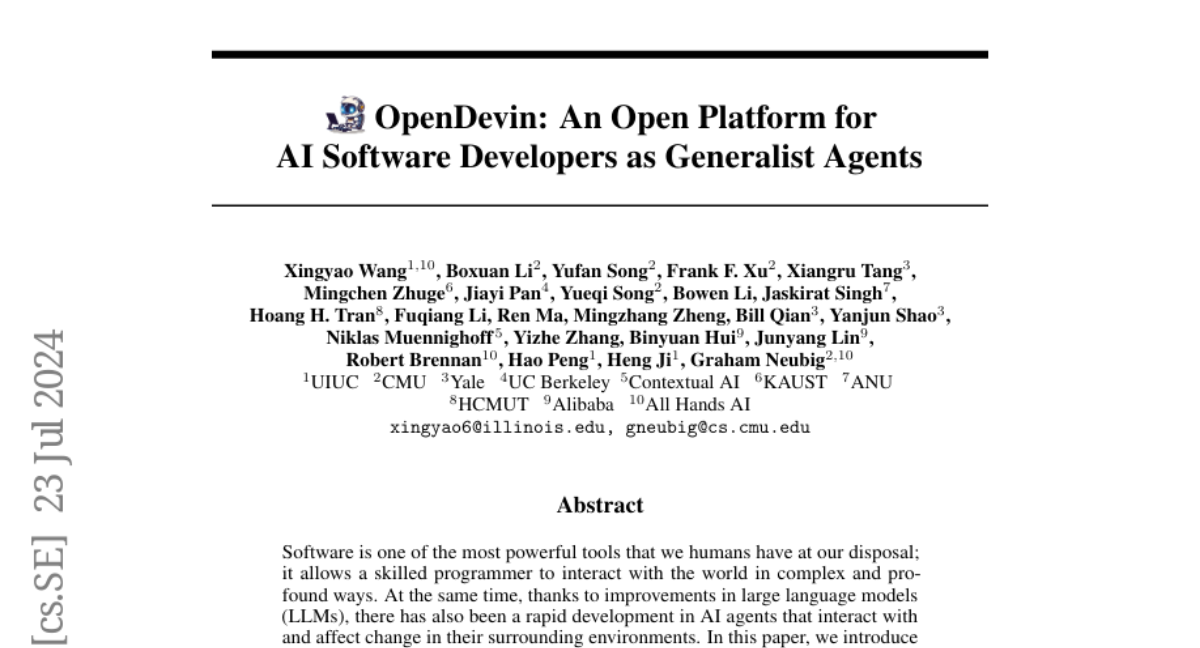
OpenDevin: An Open Platform for AI Software Developers as Generalist Agents

OpenDevin is a platform for developing AI agents that interact with the world by writing code, using command lines, and browsing the web, with support for multiple agents and evaluation benchmarks.

  • 24 authors
· Jul 23, 2024
Submitted by
Rbin

RAG-Anything: All-in-One RAG Framework

RAG-Anything is a unified framework that enhances multimodal knowledge retrieval by integrating cross-modal relationships and semantic matching, outperforming existing methods on complex benchmarks.

Submitted by
nielsr

Geometric Context Transformer for Streaming 3D Reconstruction

LingBot-Map is a feed-forward 3D foundation model that reconstructs scenes from video streams using a geometric context transformer architecture with specialized attention mechanisms for coordinate grounding, dense geometric cues, and long-range drift correction, achieving stable real-time performance at 20 FPS.

robbyant Robbyant · Apr 15, 2026
Submitted by
andito

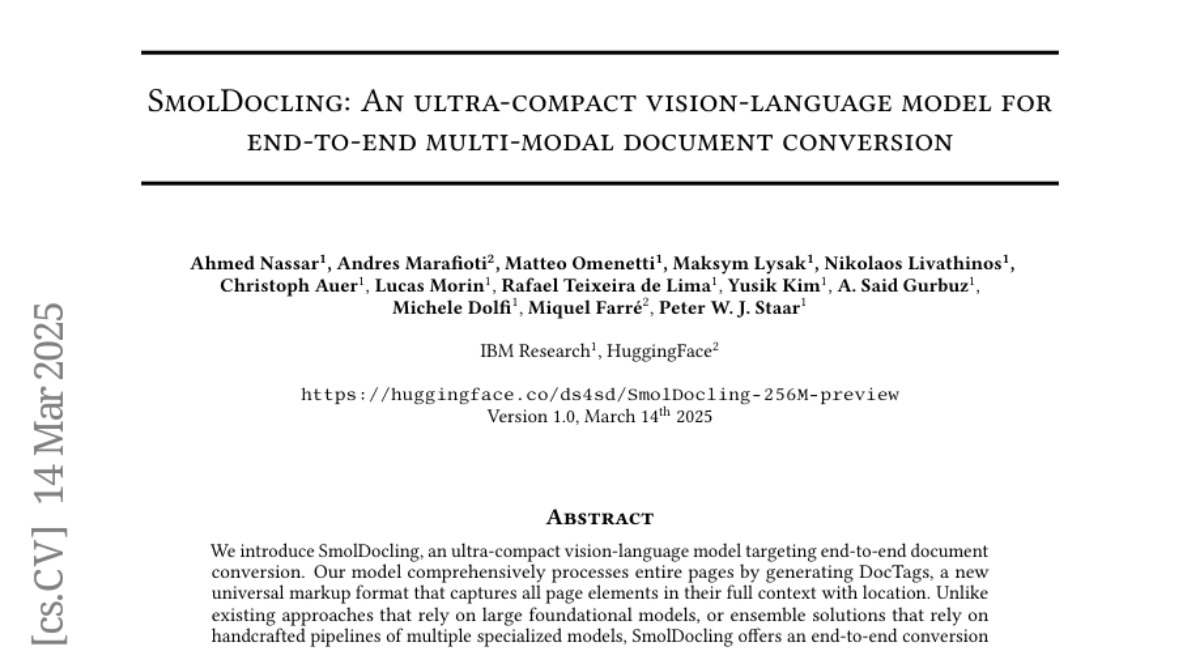
SmolDocling: An ultra-compact vision-language model for end-to-end multi-modal document conversion

SmolDocling is a compact vision-language model that performs end-to-end document conversion with robust performance across various document types using 256M parameters and a new markup format.

ibm-granite IBM Granite · Mar 14, 2025

OmniFlatten: An End-to-end GPT Model for Seamless Voice Conversation

A novel GPT-based model, OmniFlatten, enables real-time natural full-duplex spoken dialogue through a multi-stage post-training technique that integrates speech and text without altering the original model's architecture.

  • 9 authors
· Oct 23, 2024

AutoDev: Automated AI-Driven Development

AutoDev is an AI-driven software development framework that automates complex engineering tasks within a secure Docker environment, achieving high performance in code and test generation.

  • 5 authors
· Mar 13, 2024
Submitted by
taesiri

PersonaLive! Expressive Portrait Image Animation for Live Streaming

PersonaLive is a diffusion-based portrait animation framework that improves real-time performance through hybrid implicit signals, appearance distillation, and autoregressive streaming generation.

A decoder-only foundation model for time-series forecasting

A large language model adapted for time-series forecasting achieves near-optimal zero-shot performance on diverse datasets across different time scales and granularities.

  • 4 authors
· Oct 14, 2023

LightRAG: Simple and Fast Retrieval-Augmented Generation

LightRAG improves Retrieval-Augmented Generation by integrating graph structures for enhanced contextual awareness and efficient information retrieval, achieving better accuracy and response times.

  • 5 authors
· Oct 8, 2024
Submitted by
huiwon

RLDX-1 Technical Report

RLDX-1 is a general-purpose robotic policy for dexterous manipulation that integrates heterogeneous modalities through a Multi-Stream Action Transformer architecture, demonstrating superior performance in complex real-world tasks compared to existing vision-language-action models.

RLWRLD RLWRLD · May 5, 2026
Submitted by
Wyattz23

QuantAgent: Price-Driven Multi-Agent LLMs for High-Frequency Trading

QuantAgent, a multi-agent LLM framework, excels in high-frequency trading by leveraging specialized agents for technical indicators, chart patterns, trends, and risk, outperforming existing neural and rule-based systems.

  • 5 authors
· Sep 12, 2025
Submitted by
csuhan

OpenGame: Open Agentic Coding for Games

OpenGame is an open-source agentic framework for end-to-end web game creation that uses specialized code models and evaluation benchmarks to overcome challenges in interactive application development.

  • 11 authors
· Apr 20, 2026

EverMemOS: A Self-Organizing Memory Operating System for Structured Long-Horizon Reasoning

EverMemOS presents a self-organizing memory system for large language models that processes dialogue streams into structured memory cells and scenes to enhance long-term interaction capabilities.

  • 11 authors
· Jan 5, 2026
Submitted by
ZhuofengLi

Beyond Semantic Similarity: Rethinking Retrieval for Agentic Search via Direct Corpus Interaction

Direct corpus interaction enables more effective agentic search by allowing agents to query raw text directly, outperforming traditional retrieval methods in complex tasks.

TIGER-Lab TIGER-Lab · May 3, 2026
Submitted by
akhaliq

LlamaFactory: Unified Efficient Fine-Tuning of 100+ Language Models

LlamaFactory is a unified framework enabling efficient fine-tuning of large language models across various tasks using a web-based user interface.

  • 5 authors
· Mar 20, 2024
Submitted by
lovesnowbest

UI-TARS-2 Technical Report: Advancing GUI Agent with Multi-Turn Reinforcement Learning

UI-TARS-2, a native GUI-centered agent model, addresses challenges in data scalability, multi-turn reinforcement learning, and environment stability, achieving significant improvements over its predecessor and strong baselines across various benchmarks.

ByteDance-Seed ByteDance Seed · Sep 2, 2025
Submitted by
akhaliq

Very Large-Scale Multi-Agent Simulation in AgentScope

Enhancements to the AgentScope platform improve scalability, efficiency, and ease of use for large-scale multi-agent simulations through distributed mechanisms, flexible environments, and user-friendly tools.

  • 8 authors
· Jul 25, 2024
Submitted by
youganglyu

EvoScientist: Towards Multi-Agent Evolving AI Scientists for End-to-End Scientific Discovery

EvoScientist is an adaptive multi-agent framework that enhances scientific discovery by continuously learning from past interactions through persistent memory modules.

  • 12 authors
· Mar 9, 2026
Submitted by
taesiri

AgentScope 1.0: A Developer-Centric Framework for Building Agentic Applications

AgentScope enhances agentic applications by providing flexible tool-based interactions, unified interfaces, and advanced infrastructure based on the ReAct paradigm, supporting efficient and safe development and deployment.

  • 23 authors
· Aug 22, 2025
Submitted by
hao-li

Agent READMEs: An Empirical Study of Context Files for Agentic Coding

Agentic coding tools receive goals written in natural language as input, break them down into specific tasks, and write or execute the actual code with minimal human intervention. Central to this process are agent context files ("READMEs for agents") that provide persistent, project-level instructions. In this paper, we conduct the first large-scale empirical study of 2,303 agent context files from 1,925 repositories to characterize their structure, maintenance, and content. We find that these files are not static documentation but complex, difficult-to-read artifacts that evolve like configuration code, maintained through frequent, small additions. Our content analysis of 16 instruction types shows that developers prioritize functional context, such as build and run commands (62.3%), implementation details (69.9%), and architecture (67.7%). We also identify a significant gap: non-functional requirements like security (14.5%) and performance (14.5%) are rarely specified. These findings indicate that while developers use context files to make agents functional, they provide few guardrails to ensure that agent-written code is secure or performant, highlighting the need for improved tooling and practices.

  • 11 authors
· Nov 17, 2025
Submitted by
byliutao

Continuous-Time Distribution Matching for Few-Step Diffusion Distillation

Continuous-Time Distribution Matching migrates diffusion model distillation from discrete to continuous optimization, enabling arbitrary points along sampling trajectories and preserving fine visual details through dynamic scheduling and velocity field extrapolation.

alibaba-inc alibaba-inc · May 7, 2026

Tequila: Trapping-free Ternary Quantization for Large Language Models

Tequila, a trapping-free quantization method, enhances ternary quantization of Large Language Models by repurposing deadzone-trapped weights as dynamic biases, improving accuracy and inference speed.

  • 10 authors
· Sep 28, 2025
Submitted by
Jiafei1224

MolmoAct2: Action Reasoning Models for Real-world Deployment

MolmoAct2 presents an open-action reasoning model for robotics that improves upon previous systems through specialized vision-language-model backbones, new datasets, open-weight action tokenizers, architectural redesign for continuous-action prediction, and adaptive reasoning for reduced latency.

allenai Ai2 · May 4, 2026

Zep: A Temporal Knowledge Graph Architecture for Agent Memory

Zep, a memory layer service, outperforms MemGPT in the DMR benchmark and LongMemEval by excelling in dynamic knowledge integration and temporal reasoning, critical for enterprise use cases.

  • 5 authors
· Jan 20, 2025
Submitted by
csfufu

OpenSearch-VL: An Open Recipe for Frontier Multimodal Search Agents

OpenSearch-VL presents an open-source framework for training advanced multimodal search agents using reinforcement learning, featuring specialized data curation, diverse tool environments, and a novel training algorithm that improves performance across multiple benchmarks.

Tencent-Hunyuan Tencent Hunyuan · May 6, 2026

Continuous Audio Language Models

Audio Language Models (ALM) have emerged as the dominant paradigm for speech and music generation by representing audio as sequences of discrete tokens. Yet, unlike text tokens, which are invertible, audio tokens are extracted from lossy codecs with a limited bitrate. As a consequence, increasing audio quality requires generating more tokens, which imposes a trade-off between fidelity and computational cost. We address this issue by studying Continuous Audio Language Models (CALM). These models instantiate a large Transformer backbone that produces a contextual embedding at every timestep. This sequential information then conditions an MLP that generates the next continuous frame of an audio VAE through consistency modeling. By avoiding lossy compression, CALM achieves higher quality at lower computational cost than their discrete counterpart. Experiments on speech and music demonstrate improved efficiency and fidelity over state-of-the-art discrete audio language models, facilitating lightweight, high-quality audio generation. Samples are available at https://continuous-audio-language-models.github.io

  • 5 authors
· Sep 8, 2025
Submitted by
yhyang-myron

PhysForge: Generating Physics-Grounded 3D Assets for Interactive Virtual World

PhysForge generates interactive 3D assets by combining visual-language modeling for physical planning with a physics-grounded diffusion model that synthesizes detailed geometry and kinematic parameters through a novel injection mechanism.

  • 10 authors
· May 6, 2026

Self-Supervised Prompt Optimization

A self-supervised framework optimizes prompts for both closed and open-ended tasks by evaluating LLM outputs without external references, reducing costs and required data.

  • 9 authors
· Feb 7, 2025

LeWorldModel: Stable End-to-End Joint-Embedding Predictive Architecture from Pixels

LeWorldModel presents a stable end-to-end JEPA framework that trains efficiently from raw pixels using minimal loss terms while maintaining competitive performance in control tasks and encoding meaningful physical structures.

galilai-group galilai-group · Mar 13, 2026
Submitted by
akhaliq

3D Gaussian Splatting for Real-Time Radiance Field Rendering

A method using 3D Gaussians for scene representation and optimized rendering allows high-quality, real-time novel-view synthesis at 1080p resolution.

  • 4 authors
· Aug 8, 2023
Submitted by
taesiri

DeepCode: Open Agentic Coding

DeepCode, a fully autonomous framework, addresses the challenges of document-to-codebase synthesis by optimizing information flow through source compression, structured indexing, knowledge injection, and error correction, achieving state-of-the-art performance and surpassing human experts.

  • 5 authors
· Dec 8, 2025
Submitted by
taesiri

LTX-2: Efficient Joint Audio-Visual Foundation Model

LTX-2 is an open-source audiovisual diffusion model that generates synchronized video and audio content using a dual-stream transformer architecture with cross-modal attention and classifier-free guidance.

  • 29 authors
· Jan 6, 2026
Submitted by
taesiri

Representation Fréchet Loss for Visual Generation

Fréchet Distance can be effectively optimized as a training objective when decoupling population size from batch size, leading to improved generator quality and alternative evaluation metrics.

  • 5 authors
· Apr 30, 2026
Submitted by
DyJiang

D-OPSD: On-Policy Self-Distillation for Continuously Tuning Step-Distilled Diffusion Models

A new training approach called D-OPSD enables efficient supervised fine-tuning for diffusion models by leveraging on-policy self-distillation with text and multimodal features while preserving few-step inference capabilities.

Tongyi-MAI Tongyi-MAI · May 6, 2026
Submitted by
LazySheeep

SwiftI2V: Efficient High-Resolution Image-to-Video Generation via Conditional Segment-wise Generation

SwiftI2V is an efficient high-resolution image-to-video generation framework that uses conditional segment-wise generation and bidirectional contextual interaction to achieve scalable, input-faithful video synthesis with reduced computational requirements.

  • 6 authors
· May 7, 2026
Submitted by
taesiri

Fish Audio S2 Technical Report

Fish Audio S2 is an open-source text-to-speech system with multi-speaker capabilities, multi-turn generation, and instruction-following control through natural-language descriptions, utilizing a multi-stage training approach and production-ready inference engine.

fishaudio Fish Audio · Mar 9, 2026
Submitted by
taesiri

Qwen3-TTS Technical Report

The Qwen3-TTS series presents advanced multilingual text-to-speech models with voice cloning and controllable speech generation capabilities, utilizing dual-track LM architecture and specialized speech tokenizers for efficient streaming synthesis.

Qwen Qwen · Jan 22, 2026
Submitted by
tricktreat

ClawGUI: A Unified Framework for Training, Evaluating, and Deploying GUI Agents

ClawGUI presents an open-source framework that addresses key challenges in GUI agent development through unified reinforcement learning, standardized evaluation, and cross-platform deployment capabilities.

zju Zhejiang University · Apr 13, 2026