
Latent evolving World Action Model
Paper • 2609.27455 • Published • 2
Xueji Fang1,2,3, Boqiang Duan3, Hua Wu3, Jingdong Wang3,†,‡, Guo-Jun Qi2,†
1 Zhejiang University 2 Westlake University 3 Baidu Inc.
† Corresponding authors ‡ Project leader
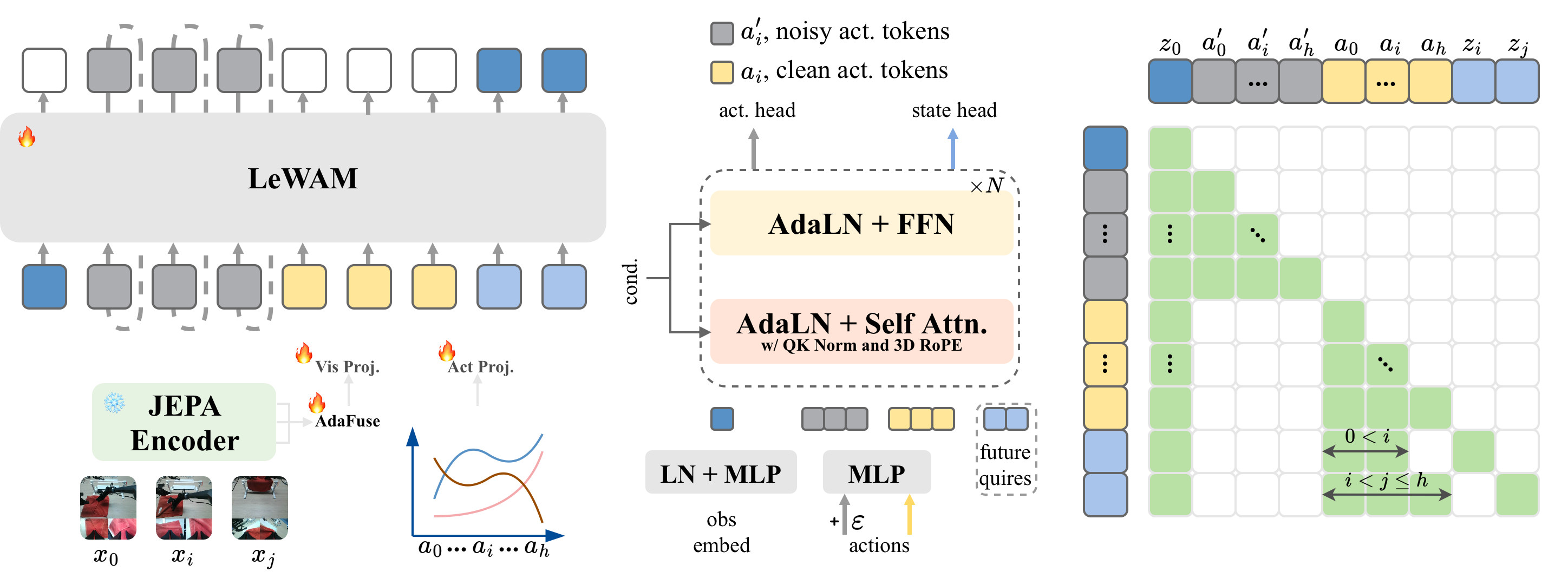
LeWAM learns robot actions and visual dynamics in JEPA embedding space, without a pretrained video diffusion backbone. Our controlled comparison of frozen visual encoders finds I-JEPA-Huge most effective for action generation among the evaluated encoders.
With 0.4B trainable parameters, LeWAM achieves 92.28% average success on RoboTwin 2.0. Its policy is trained on RoboTwin demonstrations without additional robot pretraining data; the frozen I-JEPA encoder retains its ImageNet-22K pretraining.
This repository hosts the official model checkpoints for Latent evolving World Action Model.
LeWAM achieves the highest average success rate among the models listed below, with 0.4B trainable parameters and no additional robot pretraining.
All success rates are reported as percentages. Results are from Table 2 of the paper.
| Model | Visual Encoder | Trainable Params. | Robot Pretraining | Clean ↑ | Randomized ↑ | Average ↑ |
|---|---|---|---|---|---|---|
| π₀ | SigLIP | 3B | ✓ | 65.92 | 58.40 | 62.16 |
| π₀.₅ | SigLIP | 3B | ✓ | 82.74 | 76.76 | 79.75 |
| Motus w/o Pretrain | Wan2.2-VAE | 6B | ✗ | 77.56 | 77.00 | 77.28 |
| LingBot-VA w/o Pretrain | Wan2.2-VAE | 5B | ✗ | 80.60 | — | 80.60 |
| GigaWorld-Policy | Wan2.2-VAE | 5B | ✓ | 86.36 | 85.04 | 85.70 |
| Motus | Wan2.2-VAE | 6B | ✓ | 88.66 | 87.02 | 87.84 |
| Fast-WAM | Wan2.2-VAE | 6B | ✗ | 91.88 | 91.78 | 91.83 |
| LingBot-VA | Wan2.2-VAE | 5B | ✓ | 92.90 | 91.50 | 92.20 |
| LaWAM | DINOv3-B/16 | 1.7B | ✓ | 92.64 | 89.80 | 91.22 |
| LeWAM (Ours) | I-JEPA-H/14 | 0.4B | ✗ | 93.14 | 91.42 | 92.28 |
Bold indicates the highest success rate in each column. — indicates an unreported result. The Average entry for LingBot-VA w/o Pretrain reflects its available Clean result only.
Robot Pretraining refers to additional robot pretraining, not visual-encoder pretraining. LeWAM's frozen I-JEPA encoder retains its ImageNet-22K pretraining.
All LeWAM variants use the same frozen I-JEPA-H/14 encoder and 0.4B trainable parameters, without additional robot pretraining.
| Variant | Clean ↑ | Randomized ↑ | Average ↑ |
|---|---|---|---|
| Action Only | 88.42 | 83.92 | 86.17 |
| + WM (FM) | 88.18 | 84.24 | 86.21 |
| + WM | 88.86 | 85.18 | 87.02 |
| + WM + AdaFuse | 91.32 | 90.06 | 90.69 |
| LeWAM (+ DemoDPO) | 93.14 | 91.42 | 92.28 |
WM denotes world modeling through future embedding prediction. WM (FM) uses flow matching for future embedding prediction.
AdaFuse improves average success from 87.02% to 90.69%. DemoDPO further improves it to 92.28%, using demonstration-derived preferences without additional environment interaction.
For the complete experimental protocol, baseline configurations, encoder comparisons, and real-world manipulation results, see the paper.
| Property | Description |
|---|---|
| Model name | LeWAM |
| Expanded name | Latent Evolving World Action Model |
| Model type | JEPA-space World Action Model |
| Task | Robot manipulation |
| Vision encoder | Frozen I-JEPA-Huge |
| Trainable model size | Approximately 0.4B parameters |
| Action dimension | 14 in the released RoboTwin configuration |
| Action prediction horizon | 32 actions per inference call |
| Default inference steps | 10 |
| Scheduler | FlowMatchEulerDiscreteScheduler |
| Evaluation code | Custom LeWAM pipeline and RoboTwin evaluation runner |
The 0.4B parameter count refers to trainable parameters, excluding the frozen vision encoder.
The vision encoder is based on facebook/ijepa_vith14_22k and remains frozen during LeWAM training.
| Path | Contents |
|---|---|
model_index.json |
LeWAM pipeline configuration |
predictor/ |
LeWAM predictor configuration and weights |
vision_encoder/ |
Frozen I-JEPA-Huge encoder, configuration, and preprocessing files |
scheduler/ |
Inference scheduler configuration |
stats/dataset_stats.json |
RoboTwin action statistics |
Download the complete repository together, including the vision encoder and action statistics:
hf download XuejiFang/LeWAM --local-dir outputs/lewam
Clone the official code repository:
git clone https://github.com/XuejiFang/LeWAM.git
cd LeWAM
Set up the Python 3.10 evaluation environment with uv:
git submodule update --init --recursive
uv run --no-project --python 3.10 scripts/setup_environment.py
For evaluation, download the simulation assets into third_party/RoboTwin/assets, then update the embodiment configuration paths:
cd third_party/RoboTwin
../../.venvs/robotwin/bin/python scripts/update_embodiment_config_path.py
cd ../..
Evaluation requires an NVIDIA driver, CUDA 12.x toolkit, a C++ compiler, libvulkan1, and ffmpeg.
LeWAM uses a custom robotics pipeline implemented in the official code repository. Its checkpoint format uses Diffusers components, but it is not a text-to-image model.
Use the LeWAM inference and evaluation code rather than a generic text-to-image DiffusionPipeline example. The released configuration predicts 32 actions per inference call using 10 inference steps. Action execution and replanning are handled by the evaluation runner.
Download the complete LeWAM checkpoint, including the I-JEPA encoder, to outputs/lewam, and evaluate a single task:
.venvs/robotwin/bin/hf download XuejiFang/LeWAM --local-dir outputs/lewam

.venvs/robotwin/bin/python experiments/robotwin/run_robotwin_manager.py \
  EVALUATION.task_name=adjust_bottle
Omit EVALUATION.task_name=adjust_bottle to evaluate all 50 tasks.
By default, evaluation uses seed 42 and 100 expert-validated scenes for each task and setting, covering demo_clean and demo_randomized. Results and generated scene lists are saved under outputs/evaluation/.
GPU selection, concurrency, and video settings are configured in configs/eval/sim_robotwin.yaml.
.venvs/robotwin/bin/python experiments/robotwin/run_robotwin_manager.py \
  ckpt=/path/to/epoch_10_ema \
  EVALUATION.dataset_stats_path=/path/to/dataset_stats.json
.venvs/robotwin/bin/python experiments/robotwin/run_robotwin_manager.py \
  EVALUATION.cases_dir=/path/to/cases
For fixed-case evaluation, name each saved case list <task>__<setting>.json.
The bundled I-JEPA-Huge vision encoder is licensed under CC BY-NC 4.0. See the encoder's original model card and the documentation in vision_encoder/ for details.
This license statement applies to the bundled vision encoder. Check the applicable licenses for the LeWAM predictor, code, and other components before redistribution or commercial use.
If you use LeWAM in your research, please cite:
@article{fang2026lewam,
  title={Latent evolving World Action Model},
  author={Fang, Xueji and Duan, Boqiang and Wu, Hua and Wang, Jingdong and Qi, Guo-Jun},
  journal={arXiv preprint arXiv:2609.27455},
  year={2026}
}
We thank LeWM, Fast-WAM, and RoboTwin for their code and resources.